relocation · 5 min read
Rural Europe for Online Entrepreneurs and Remote Workers (2026)
Earn online, live in a cheap European small town: the case for rural Italy, the real downsides (schools, hospitals, taxes) and who it suits today.
By Nicola Amadio · April 1, 2026
Originally sent as a Remote Goats newsletter issue.
Make money online, then go live in a cheap, beautiful European small town. It is a popular idea on social media right now. Some people idealise it, and some make the move and turn it into a content business: buy a house on a hill, renovate it, and enjoy the lifestyle.
I grew up in a small town in central Italy on the Adriatic coast and left at 18. I only go back for holidays. So here is my view on whether rural Europe works, using Italy as the example.
Why it is so cheap
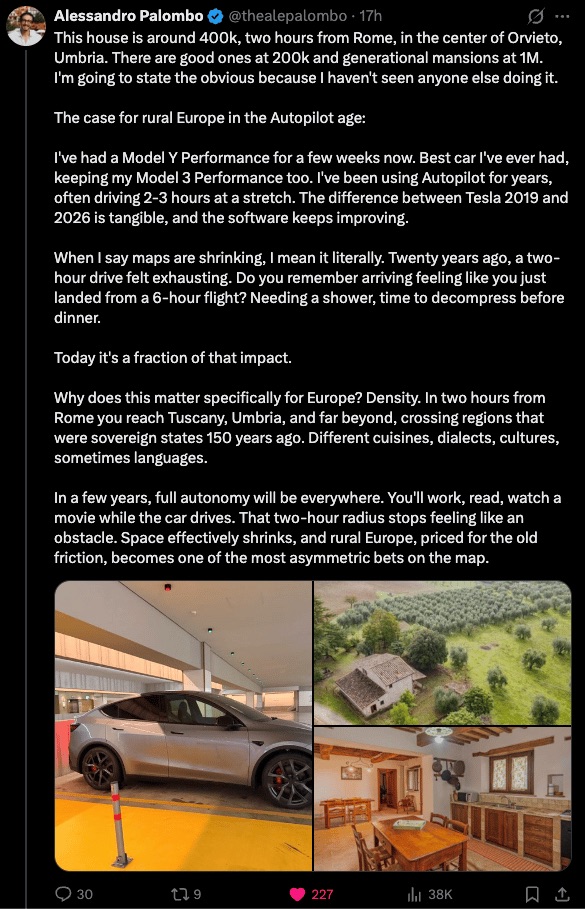
Prices really are low in some areas, and not only for housing but for daily life too. A house two hours from Rome can cost around 400,000 euros, and there are decent ones for 200,000.
There are reasons for that, at least in Italy:
- The south is the cheapest, but also the most de-industrialised. Fewer jobs and services nearby.
- Organised crime exists in pockets. Rule of law is relatively strong overall, but not everywhere.
- High tax risk. An old population, high public debt and high public spending mean the risk of higher taxes reaching you is real.
Why it can still be good value
- The most UNESCO World Heritage sites of any country.
- Arguably the best food in the world, and a lifestyle that is a brand of its own.
- A large, diverse economy: luxury, manufacturing, tourism, food and fashion.
- Mountains, sea and cities usually within a three hour drive.
- A skilled and fairly priced workforce if you need to hire.
- A convenient location in Europe.
- Legal ways to pay less tax, if you are willing to deal with complexity and bureaucracy.
A lunch in a hilltop restaurant 15 minutes from the coast shows the gap. A bottle of wine that costs 80 euros in a shop costs 120 at the table, where in Warsaw you would pay two to two and a half times retail and in Zurich three to three and a half times.
The vibe argument
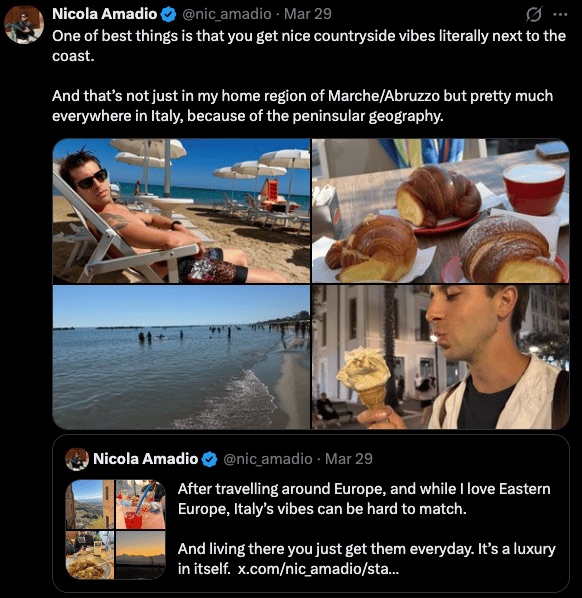
I love Eastern Europe, but Italian everyday life is hard to match, and if you live there you get it every day. That is a luxury in itself.
Because Italy is a long, narrow peninsula, you get countryside right next to the coast. That is true in my home region of Marche and Abruzzo, and in most of the country.
A healthier way of life
There is a lot of talk online about longevity, wearables, strict diets and metrics. When I ask older people in Italy how they reached their 90s (my grandparents are 88 and 91), the answers are simpler:
- Do not eat too much, and move every day.
- Spend time outside.
- Do not work too much, drink too much or smoke too much.
- Do work you care about.
- Keep loving relationships and look after the people around you.
The message is balance, and a slower small town life makes that easier. Chronic stress from overwork is one of the least healthy things there is.
The case that may be coming
One argument I find interesting: self-driving cars could make rural Europe much more practical. If a two hour drive feels like nothing because the car drives itself, a farmhouse two hours from Rome is suddenly close to Tuscany, Umbria and a major city. Europe is dense, so a two hour radius covers a lot of different regions, food and culture. If that happens, rural property priced for today's friction could look cheap in hindsight.
My verdict
It can work for some people, not for everyone. For now it is still a niche move.
The serious downside is the lack of decent infrastructure close by:
- Schools
- Hospitals
- Shopping and everyday services
As a mainstream option, I think it needs more time. But if you have no kids and you want a slower, more rural way of life, it could already be the right time. It is not for me at this point in my life, but maybe one day. Plenty of people who leave for New York, Hong Kong, San Francisco, London or Zurich end up coming back.
If you like the idea but want lower taxes than Italy, compare the Greek low-tax setup and Slovenia's normirani s.p., and read why lower-cost cities do not always save you more.
FAQ
Is rural Italy a good place to live with a remote income?
It can be, if you value food, nature and a slow pace over services. Housing and daily costs are low, but you give up easy access to good schools, hospitals and shops, and Italian taxes are high unless you qualify for a special regime.
How much does a house in rural Italy cost?
It varies a lot by region. Two hours from Rome, renovated country houses go for around 200,000 to 400,000 euros, and large historic properties for around a million. The south is cheaper still.
What are the biggest downsides of moving to rural Europe?
Distance from schools and hospitals, fewer services, a car dependent life and, in Italy, high taxes and bureaucracy. Some areas are also economically declining.
Who is rural Europe best suited for?
People without school age kids, with a stable online income, who want a slower and more rural lifestyle and do not mind driving for everyday needs.
Not sure which country fits your income and priorities? The Relocation Advisor ranks 25+ countries for remote workers, and the remote jobs index lists roles you can take anywhere.
Get the Remote Goats newsletter
Relocation strategy, low-tax setups, and six-figure remote roles, straight to your inbox. No spam.
Jobs
Remote $100k+ jobs by country
Plan your move
Get a personalized relocation plan
Keep reading
Greece's Low-Tax Setup for Remote Workers: The 50% Exemption Explained (2026)
Share this article
Related articles
Greece's Low-Tax Setup for Remote Workers: The 50% Exemption Explained (2026)
Greece's inbound-professional regime gives remote workers and online entrepreneurs a 50% income-tax exemption for 7 years — pushing effective rates to ~12–16% at €60–80k. Worked examples, who qualifies, and how it compares to Slovenia, Cyprus and Portugal in 2026.
Sion, Valais vs Lugano, Ticino for Remote Workers and Online Business Owners
Sion (Valais) vs Lugano (Ticino) for remote workers and founders: the French- and Italian-speaking Swiss bases compared on cost, tax, weather, size and lifestyle.